Thistle from A to Z
Chapter 1 · Start here1 of 53
Welcome. Start here.
This guide takes you from knowing nothing to understanding everything you need, in about 45 minutes.
You do not need to know anything about investing, Bitcoin or the stock market. Every page explains one idea in plain words, and each builds on the one before.
- Press Next to move on and Back to return. The guide remembers where you stopped.
- A word with a dotted line under it, like , is explained when you tap it. All of them are in the A to Z at the end.
- Contents shows every page, so you can jump straight to the one you need later.
By the end you will know what Thistle does, what the two products are, how they have done, what can go wrong, how to open an account, how to put money in, how to connect it, and how to take money out again.
CarefulThis guide teaches. It is not personal financial advice. Only you can decide whether this is right for your money, and you should never invest money you will need in the next few years.
In one lineRead it once from start to finish, then use it as a reference.
Chapter 1 · Start here2 of 53
What Thistle is, in one minute
Software that trades two markets for you, inside your own account, by fixed rules.
Thistle^ makes Super Intelligence Trading: a trading engine, which is software that decides when to buy and when to sell, and then places those orders by itself.
It trades two things: , and the , which is the 500 or so largest companies in America bought together.
The important part is where your money sits. It never comes to us.
You open an account in your own name at a well-known or . Your money goes there and stays there. You then give Thistle a limited pass, called an , that lets the software place trades in that account. The pass cannot take money out.
In one lineYour account, your money, your name. Thistle only does the trading.
Chapter 1 · Start here3 of 53
What Thistle is not
Knowing what it does not do matters as much as knowing what it does.
- Not a bank and not a fund. We do not hold, pool or look after anybody's money.
- Not a promise. Nobody can guarantee a profit. The value of your account will go down as well as up, sometimes by a lot.
- Not fast trading. The software does not buy and sell all day. It can go weeks or months without placing an order.
- Not borrowing. It only ever uses the money in your account. It never borrows to make bets bigger. More on this later, under .
- Not a tip service. It does not pick coins or companies. It trades two things only, by the same rules for every member.
- Not able to move your money. The pass you give it can trade. It cannot withdraw or send money anywhere.
- Not a trap. You can switch it off, or cut its access at your exchange, at any moment. Whatever is in your account is yours.
In one lineIt is a tool that follows rules. It is not a guarantee and it never touches your money.
Chapter 1 · Start here4 of 53
The two products
One membership covers both. You can use one, or both.
| Bitcoin Super Intelligence | S&P 500 Super Intelligence | |
|---|---|---|
| What it trades | Bitcoin | The 500 largest US companies, through one fund called IVV |
| What it holds when it steps aside | USDC, a digital US dollar | US dollars, resting in short-term US government bills |
| Where your account is | A crypto exchange: Binance, Kraken, Bybit, OKX, Phemex and Bitget | A stock broker: Alpaca |
| Minimum to take part | 1,000 USDC | 1,000 USD |
| How bumpy it is | Very. Bitcoin can halve and double | Much calmer, but it still falls |
| Today | in its final test phase, not placing real orders yet | live |
The two work the same way underneath. Each holds its market while the market is rising, steps aside when the rise breaks, buys back lower in steps, and returns in full when the rise is back. Only the thing traded is different.
Many people use both: the S&P 500 as the steadier part, Bitcoin as the faster and riskier part.
A product shown as in its test phase can be set up today. It places real orders in your account from the day it is switched to live, and its page on this site says so at the top.
In one lineSame idea, two markets: one wild, one calmer.
Chapter 1 · Start here5 of 53
Who is behind it
A short background, so you know what you are dealing with.
The name is THISTLE.CAPITAL, written Thistle^. Its work is building trading software and running it.
Trading by fixed rules, with software placing the orders, is how most professional trading is done today. Banks and funds have done it for decades. What is unusual here is who gets to use it: ordinary people, in their own small accounts, without handing their money to anyone.
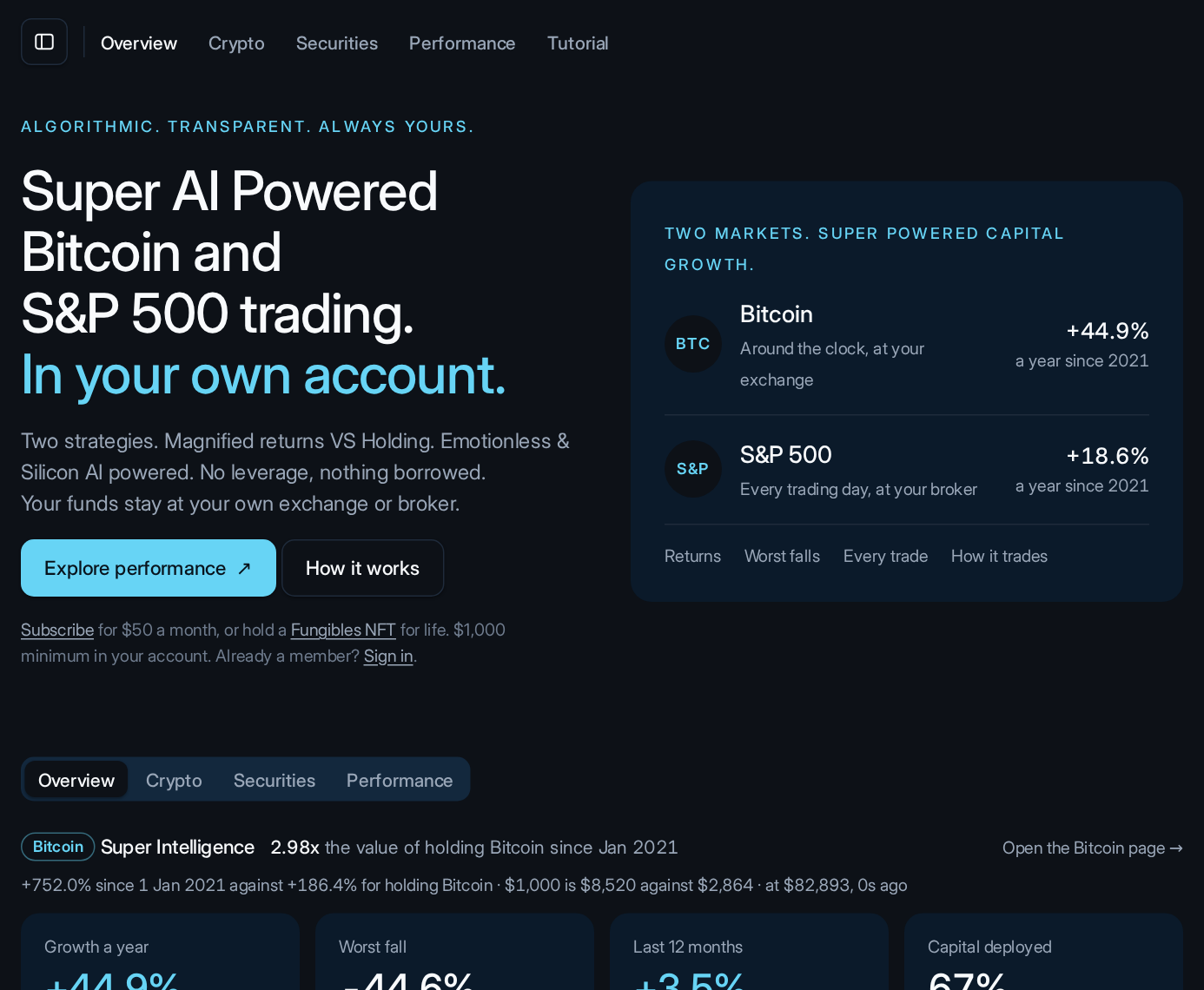
Everything the software has decided is published. On the Performance page you can see every year, every worst moment and every single trade of both strategies since January 2021. Nothing is hidden, including the bad years.
The thinking behind the brand, and what it wants to do with what it earns, is written in the Charter.
In one lineA software maker with its results in the open. Check them yourself.
Chapter 2 · The basics6 of 53
What investing is
Buying something today because you expect it to be worth more in the years ahead.
Money in a bank account is saved. It is safe, and it grows a little, often less than prices in the shops rise.
Money that is invested has been used to buy something: part of a company, or Bitcoin. That thing has a price that changes every day. If the price rises, your money has grown. If it falls, your money has shrunk, at least for now.
Three ideas carry almost everything:
- Risk. The price can fall, and stay down for a long time. This is the cost of the chance of growth.
- Time. Over days, prices are close to a coin toss. Over many years, the things traded here have risen. Time is what turns a bumpy ride into growth.
- Only spare money. If you may need the money within a few years, do not invest it. A fall could come exactly when you need it.
In one lineInvesting swaps certainty for the chance of growth, and it needs years.
Chapter 2 · The basics7 of 53
Markets, prices and trends
A market is simply everyone who wants to buy meeting everyone who wants to sell.
The price is what the last buyer and seller agreed on. When more people want to buy than sell, it rises. When more want to sell, it falls. News, fear and greed move it all day long.
Prices do not move in straight lines, but they do move in : stretches of months or years when the price is mostly rising, or mostly falling.
- A long rise is called a .
- A long fall is called a .
Nobody can know tomorrow's price. What can be seen, with some patience, is which kind of stretch the market is in now. That is the whole basis of what Thistle's software does: it does not predict, it follows.
In one lineYou cannot know the next price. You can see the direction of the last months.
Chapter 2 · The basics9 of 53
A fund, and what IVV is
You cannot buy an index directly. You buy a fund that holds everything in it.
A collects money from many people and buys the companies for them. An is a fund that you can buy and sell on the stock market like a single share.
IVV is the iShares Core S&P 500 ETF. It holds the shares of the companies in the S&P 500 in the same proportions, so one share of IVV rises and falls with the index. It is one of the largest funds in the world, about $896 billion, and one of the cheapest, costing 0.03% of your holding a year, taken quietly inside its price.
The S&P 500 strategy buys and sells this one fund. You never have to pick a company.
You can buy a part of a share, called a , so you do not need the full price of one.
More about the fund, with today's figures, is on the Securities page.
In one lineIVV is the whole S&P 500 in one thing you can buy.
Chapter 2 · The basics10 of 53
What Bitcoin is
Digital money that no company or government issues, with a fixed supply.
is money that exists only as records on a shared public list, kept in step by thousands of computers around the world. Nobody owns the system and nobody can print more.
- Fixed supply. Only 21 million can ever exist. About 20.1 million exist already.
- You can own a fraction. One bitcoin costs about $82,967 today, but you can own a thousandth of one, or less.
- It trades all day, every day. There are no opening hours and no weekends.
People buy it because the supply is limited, a little like digital gold. Its price depends only on what people will pay, so it swings far more than shares do.
CarefulBitcoin has fallen by more than three quarters from a high, more than once, and taken years to recover. Anyone who holds it has to be ready for that.
More on the Crypto page, including the original nine-page paper that started it.
In one lineScarce digital money with a wild price.
Chapter 2 · The basics11 of 53
Dollars, and what USDC is
A digital US dollar that can sit on a crypto exchange.
Both strategies are measured in US dollars, the currency the world's markets are priced in. If your own money is in euros, pounds or something else, it is changed into dollars on the way in.
A crypto exchange cannot hold ordinary bank dollars for trading the way a bank does. It uses a digital stand-in called a : a coin designed to always be worth one dollar.
USDC is the one used here. One USDC is meant to be worth one US dollar, and the company that issues it holds dollars and US government bills to back each coin. It is the stablecoin allowed on European exchanges, which is why it was chosen.
When the Bitcoin strategy "steps aside", it sells Bitcoin for USDC and waits. When it buys, it pays with USDC. The market it trades is written BTC/USDC, which reads "Bitcoin priced in USDC". That is called a .
If your everyday money is not the US dollar, remember that the rate between your currency and the dollar moves too. A year in which the dollar falls against your currency takes something off your result, and a year in which it rises adds to it.
CarefulA stablecoin is not a bank deposit and carries no government guarantee. The risk that it breaks from one dollar is small but not zero.
In one lineUSDC is the dollar's stand-in on the exchange. One USDC, one dollar.
Chapter 2 · The basics12 of 53
Exchanges and brokers
The company where your account lives. Thistle calls it your venue.
To own Bitcoin or shares you need an account at a company that is allowed to buy and sell them for you.
- For Bitcoin that is a crypto . The ones Thistle works with are Binance, Kraken, Bybit, OKX, Phemex and Bitget.
- For shares and funds it is a . The one Thistle works with is Alpaca.
Thistle uses one word for both: your .
A venue is a little like a bank for investments. You open the account in your own name, prove who you are, send money in, and can send it back out to your bank whenever you like. The account, and everything in it, belongs to you.
The law makes venues check your identity before you can trade. This is normal and it is the same everywhere. It is called .
CarefulYour money is as safe as the venue it sits at. Choose a large, well-known one, and protect your login. Later pages show how.
In one lineThe venue holds your account. You own what is in it.
Chapter 2 · The basics13 of 53
The industry, in two minutes
Two worlds: the old one of shares, and the young one of crypto. Thistle works in both.
The stock market is more than a century old. Shares are bought and sold on stock exchanges through brokers, and the whole system is closely supervised. A broker must keep customers' holdings apart from its own money, and many countries protect part of an account if a broker fails.
Crypto began in 2009 with Bitcoin. Its exchanges are private companies, open all day and night, in every country that allows them. The rules are newer and differ from place to place, and the protection for customers is usually weaker than at a broker.
Trading by software is ordinary in both. Most trading in the world today is placed by programs following rules, not by people at screens.
Where Thistle sits. Thistle is none of the above. It is not an exchange, a broker, a bank or a fund. It makes the software that decides and places the orders, and it charges a flat fee for it. Your account stays with the exchange or broker you chose.
CarefulThe rules on crypto and on services like this differ between countries. It is for you to check that you are allowed to use an exchange, and this kind of software, where you live.
In one lineOld market, young market, and software that trades in your own account in both.
Chapter 2 · The basics14 of 53
Holding, and trading by rules
There are two ways to own a market. Thistle always compares itself with the simple one.
Simply holding. You buy and do nothing, through the rises and the falls. It costs nothing and needs no skill. It is called . Its weakness is that you sit through every fall in full.
Trading by rules. You follow a fixed set of rules, called a , about when to be in the market and when to be out of it. Done well, it avoids part of the big falls. Its weakness is that rules are sometimes wrong: they can sell just before a rise, or buy just before a fall.
Thistle is the second kind. To be honest about whether the rules are worth having, every figure on the site is shown beside what simply holding would have done over the same days. That comparison is called the .
If the strategy does not beat simply holding over the long run, there is no reason to use it. So that is the test, and it is always in front of you.
In one lineAlways ask: compared with just holding it, how did it do?
Chapter 2 · The basics15 of 53
Three ideas worth knowing
Percentages, the worst fall, and growth on growth.
Percentages are not symmetrical. If 1,000 falls by 50% it is 500. To get back to 1,000 it must then rise by 100%, not 50%. This is why avoiding big falls matters more than catching every rise.
| A fall of | needs a rise of | to get back |
|---|---|---|
| 10% | 11% | |
| 25% | 33% | |
| 50% | 100% | |
| 75% | 300% |
The worst fall. The biggest drop from a high point to the low that followed is the honest measure of how bad it has been. Professionals call it the . Thistle shows it everywhere as "worst fall", for the strategy and for simply holding.
Growth on growth. When gains stay in the account, next year's growth is earned on a bigger amount. Over many years this does most of the work. It is also why the strategies leave everything in your account and never pay anything out by themselves.
In one lineProtect against big falls, leave gains in, and give it years.
Chapter 3 · How the strategies work16 of 53
The one idea behind both
Be in the market while it rises. Step aside when the rise breaks. Buy back lower. Return when the rise is back.
- Hold. While the market is in a rising stretch, the whole account is in the market. This first purchase is called the .
- Step aside. When the signals say the rise is over, the holding is sold. This can be below the price it was bought at. That is the cost of getting out.
- Buy back in steps. If the price keeps falling, the software buys back in planned portions at lower and lower prices. These are called . Each one is sold again a step higher, for a small gain.
- Return in full. When the market has clearly turned up again, everything goes back in and the cycle starts over.
The software checks the market by itself, all the time. It does not get tired, greedy or scared, and it applies the same decision to every member's account at the same moment.
In one lineRide the rises, sit out part of the falls, pick up bargains on the way down.
Chapter 3 · How the strategies work17 of 53
Bitcoin Super Intelligence, step by step
The same four steps, on Bitcoin, at your own crypto exchange.
- Holds Bitcoin while the market is strong. In a settled rise your whole balance is in Bitcoin.
- Steps aside when the trend turns. The Bitcoin is sold for USDC, the digital dollar. This can be at a loss on that one purchase.
- Buys weakness in measured steps. As the price falls further it buys back in planned portions, and sells each portion again a step higher, above its own buying price.
- Returns in full when the trend is back. Everything goes back into Bitcoin.
It trades on the , which means it buys and sells real Bitcoin, paid for in full. Nothing is borrowed and nothing is bet on the price falling.
It uses no . A fall is met with planned buying, not with a panic sale.
Your balance is your size. The same decision is placed on every member's account, sized to what that account holds. Someone with 2,000 trades twice the amount of someone with 1,000, in the same direction at the same time.
The exact rules are not published, on purpose. What you can see is every decision they have ever produced, on the Crypto page.
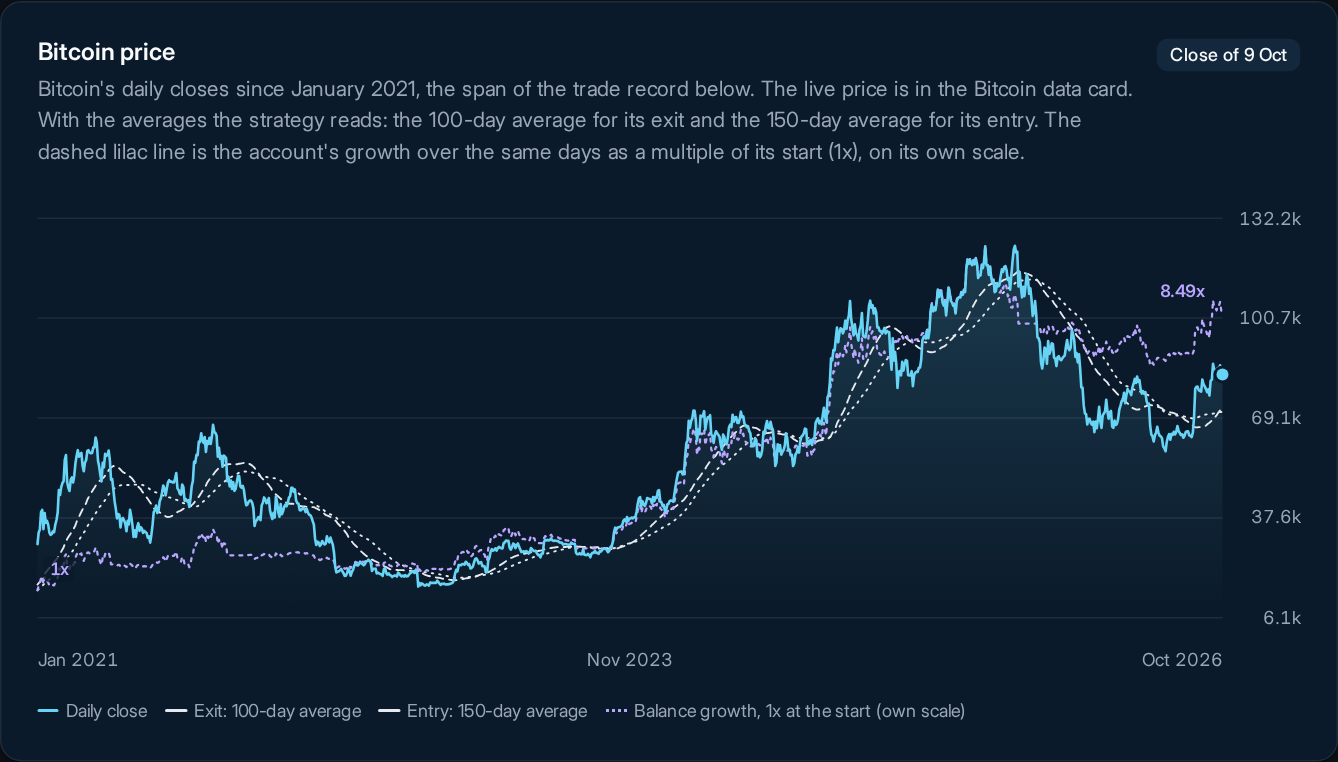
In one lineReal Bitcoin, bought in full, by four simple steps.
Chapter 3 · How the strategies work18 of 53
S&P 500 Super Intelligence, step by step
The same four steps, on the S&P 500 fund, at your own broker.
- Holds the fund while the market is strong. In a settled rise your whole balance is in IVV.
- Steps aside when the trend turns. The fund is sold and the cash waits in short-term US government bills, called , which pay a little interest. The sale can be below the buying price.
- Buys back lower. After a sale it waits for a deeper price to buy back, and sells that purchase again higher.
- Returns in full when the trend is back. Everything goes back into the fund.
It needs only an ordinary . No borrowing, no betting on falls, no stop loss.
The stock market is open on weekdays, New York time. Decisions are made on the closing price of the day and the order goes in when the market next opens. So nothing ever happens at night or at the weekend.
Because the S&P 500 moves far less than Bitcoin, this strategy trades rarely. Whole months can pass with nothing to do.
Every decision it has produced is on the Securities page.
In one lineThe whole US market in one fund, held in rises, parked in government bills in falls.
Chapter 3 · How the strategies work19 of 53
What you will actually see
Mostly, nothing. That is how it is meant to be.
New members often expect action every day. There is none.
- Long quiet stretches. While the market is rising the account simply holds. Weeks and months pass without a single order.
- All in, or mostly out. At times your whole balance is in Bitcoin or in the fund. At other times most of it is waiting in dollars. Both are normal.
- Your balance moves with the market while it holds. If Bitcoin falls 10% in a week while the strategy is holding, your balance falls about 10% too. The strategy does not protect you from ordinary bumps, only from part of the long falls.
- A sale at a loss now and then. Stepping aside sometimes means selling lower than it bought. On its own that looks like a mistake. It is the price of not riding a long fall all the way down.
- Small gains from the steps. In a falling market you will see several small buys, each sold a little higher.
- Things you must leave alone. The holdings and waiting orders in your account are the system's. A later page explains why you never add to, close or reduce them.
The picture shows the Bitcoin strategy since January 2021. The tall blocks are the months it was fully in Bitcoin. The gaps are the months it waited in dollars, and the lower shapes inside the gaps are the steps it bought back on the way down.
Every order is written to you by email the moment it happens, so you are never left guessing.
In one lineQuiet for months, then a few decisive moves. Do not judge it week by week.
Chapter 3 · How the strategies work20 of 53
Why nothing is ever borrowed
Borrowing to invest is how accounts are wiped out. Thistle never does it.
Exchanges will gladly lend you money to make bigger bets. This is called , or trading on . With 10 times leverage, a 10% rise doubles your money, and a 10% fall takes all of it.
They also offer , which are bets on the price that can be many times larger than your balance, and , which is betting that the price will fall.
Thistle uses none of these.
- It only buys with money that is in your account, and only sells what your account owns.
- The most you can lose is what you put in. You can never owe anybody anything.
- A sharp fall cannot force a sale. Borrowed positions get closed by the exchange in a crash. Yours cannot be.
You will see buttons for margin, futures and loans at your exchange. Leave them alone. Nothing here needs them.
In one lineNo borrowing means a bad year is a setback, never a wipe-out.
Chapter 3 · How the strategies work21 of 53
When the strategy does worse
It will, at times. Here is how, with real years.
No set of rules wins every year. These are the three ways it falls short, and you should expect all of them.
It lags in a roaring market. If the price shoots up straight after the strategy stepped aside, simply holding wins that year. Bitcoin in 2023: the strategy made +103%, simply holding made +156%.
It sells and has to buy back higher. A fall that turns out to be brief makes the strategy sell and then return at a higher price. Each time costs a little.
It still falls. While it is holding, or buying back in steps during a fall, your balance goes down with the market. The worst fall of the Bitcoin strategy's record is 45%. That is a great deal less than the 77% of simply holding, and it is still a very large fall to sit through.
Where it earns its place is the bad years. Bitcoin in 2022: simply holding lost -64%, the strategy -20%.
In one lineIt gives up some of the best years to soften the worst ones.
Chapter 3 · How the strategies work22 of 53
The software, and what happens if it stops
A program on a server, working around the clock, with people watching it.
The trading engine runs on Thistle's own server, day and night. It reads prices, works out whether the rules call for an order, and if they do, sends that order to every member's venue at once.
- It cannot do more than your pass allows. It can read your balance and place buy and sell orders. That is all.
- It is watched. The engine checks itself constantly and raises an alarm with the people who run it if anything looks wrong: a late price, a refused order, an account that has drifted.
- You are told. Every trade is emailed to you. If your key stops working or your balance is too low, you get an email about that too.
If the software stopped completely, nothing would be bought or sold until it was back. Your Bitcoin, your fund shares and your dollars would stay exactly where they are, in your own account, and you could sell or withdraw them yourself at your venue. Thistle is never between you and your money.
In one lineIf Thistle vanished tomorrow, your account would still be yours and still be there.
Chapter 4 · The record, and what to expect23 of 53
How to read the record
One account of 1,000, followed through every decision since January 2021.
The site shows each strategy as a single account that started with 1,000 in January 2021 and followed every buy and every sale the rules called for, at the market's real prices, day after day until today. This is called the .
A few things to know when you read it:
- It is before costs. Your venue's trading fees, your membership and any tax are not taken off. They are small beside the moves, but they are real.
- Your own result will differ. You start on a different day, with a different amount, and your orders fill at slightly different prices.
- The past is not the future. The record shows how the rules behaved in the years it covers. It does not tell you what the next years will bring. The Terms and the risk warning at the foot of every page say how past figures are produced.
Read it for its shape: how much it grew, how far it fell on the way, and how long the bad stretches lasted.
In one lineThe record shows character, not a forecast.
Chapter 4 · The record, and what to expect24 of 53
The Bitcoin record
Since January 2021, beside simply holding Bitcoin.
- Growth a year
- +44.9%vs Bitcoin held +20.0%
- Worst fall
- -44.6%vs Bitcoin held -76.6%
- Last 12 months
- +3.6%vs Bitcoin held -26.5%
- Capital deployed
- 67%on average, every lot counted
In words: 1,000 followed through every decision became about 8.5 times as much. Simply holding Bitcoin over the same days made it 2.9 times.
Notice the shape more than the end point. The line does not climb steadily. It jumps in a few strong stretches and goes sideways or down for long periods in between.
In one lineStrong growth that came in bursts, not in a straight line.
Chapter 4 · The record, and what to expect25 of 53
The Bitcoin record, year by year
Every year, beside simply holding, with the worst moment inside it.
| Year | The strategy | Simply holding Bitcoin | Worst fall inside the year |
|---|---|---|---|
| 2021 | +95.8% | +59.7% | -27.3% |
| 2022 | -19.7% | -64.2% | -26.9% |
| 2023 | +102.6% | +155.6% | -21.3% |
| 2024 | +125.0% | +121.3% | -20.1% |
| 2025 | +11.7% | -6.3% | -23.3% |
| 2026 | +6.5% | -5.4% | -14.2% |
Look at the last column as closely as the first. Even in the good years the account fell by a fifth or more at some point inside the year.
The full picture, with every single trade, is on the Performance page.
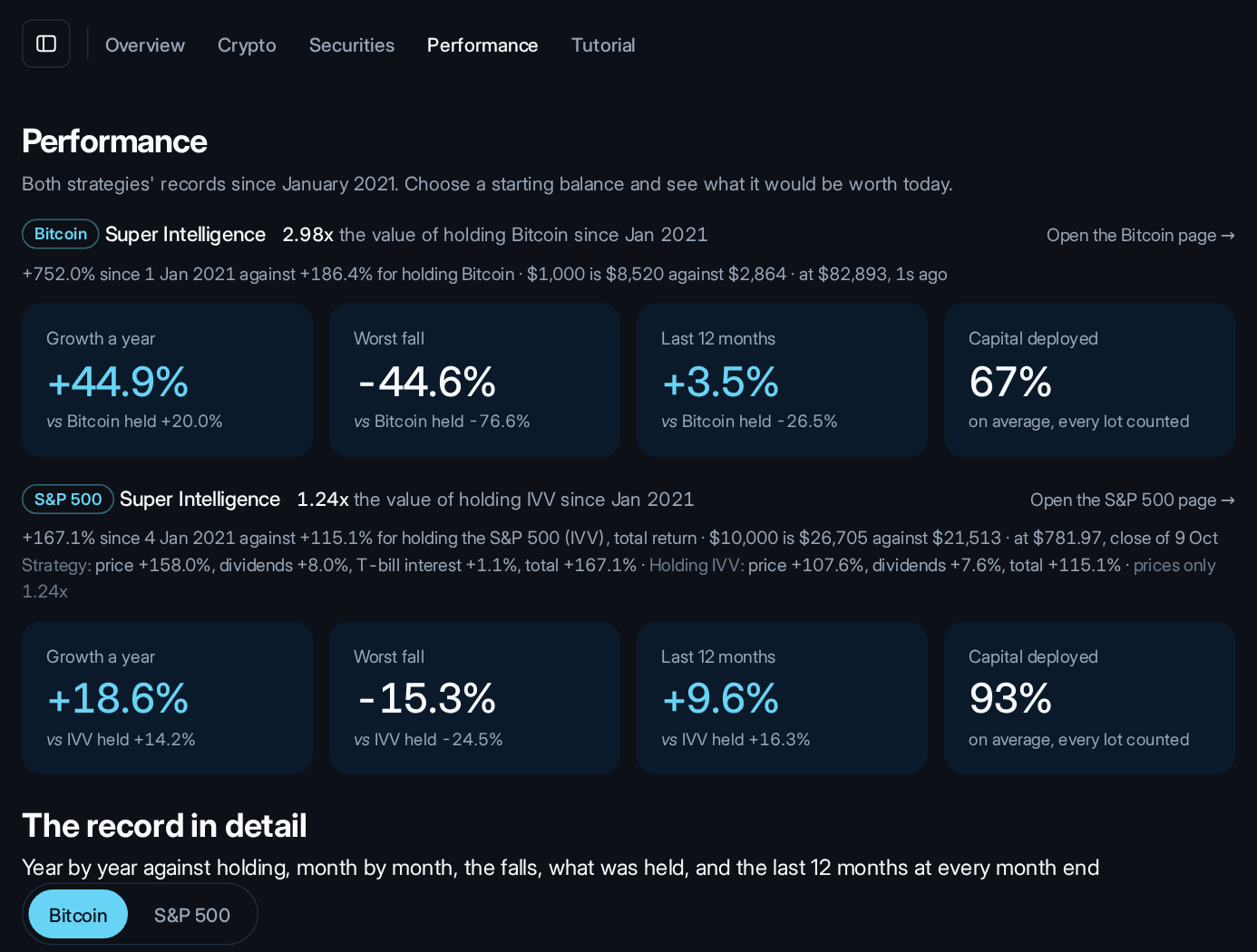
In one lineGood years and bad years, and a deep dip inside almost every one.
Chapter 4 · The record, and what to expect26 of 53
The S&P 500 record
Since January 2021, beside simply holding IVV.
- Growth a year
- +18.6%vs IVV held +14.2%
- Worst fall
- -15.3%vs IVV held -24.5%
- Last 12 months
- +9.6%vs IVV held +16.3%
- Capital deployed
- 93%on average, every lot counted
In words: 1,000 followed through every decision became about 2.7 times as much. Simply holding IVV over the same days made it 2.2 times.
The two lines stay close together. That is expected: the stock market falls less than Bitcoin, so there is less for the rules to avoid.
In one lineSteadier than Bitcoin, with a smaller edge over simply holding.
Chapter 4 · The record, and what to expect27 of 53
The S&P 500 record, year by year
Every year, beside simply holding IVV.
| Year | The strategy | Simply holding IVV | Worst fall inside the year |
|---|---|---|---|
| 2021 | +27.7% | +27.7% | -5.2% |
| 2022 | -0.2% | -18.4% | -15.3% |
| 2023 | +25.2% | +25.0% | -9.9% |
| 2024 | +23.8% | +23.7% | -8.2% |
| 2025 | +25.6% | +16.8% | -11.7% |
| 2026 | +7.7% | +14.3% | -8.6% |
In most years the two are nearly the same. The difference shows in the bad year, 2022: simply holding lost -18%, the strategy -0.2%. The strategy's use here is mostly in softening that kind of year.
In one lineClose to the market in good years, gentler in the bad one.
Chapter 4 · The record, and what to expect28 of 53
What to expect from the future
Nobody knows. Here is how to think about it honestly.
We will not tell you what you will earn, because nobody can. What the record can do is show you the range to be ready for.
Be ready for a fall as big as the worst so far, and bigger. The Bitcoin strategy has been down 45% from a high. The S&P 500 strategy has been down 15%. Worse can happen.
Be ready to wait. The Bitcoin strategy once went 17 months without getting back to an earlier high. The S&P 500 strategy went 7 months.
Be ready for years that disappoint. Some years it will make less than simply holding. Some years it will lose money.
Expect the good years to carry the result. Most of the growth in the record came from a few strong stretches. Members who left during a bad stretch missed them.
Even the calmer of the two, shown here, spent long stretches below an earlier high.
A simple test before you start: imagine opening your account and seeing it 40% lower than what you put in, a year from now. If you could leave it alone, you are ready for the Bitcoin strategy. If not, put in less, or use the S&P 500 strategy.
In one lineHope for the record. Plan for the worst fall.
Chapter 4 · The record, and what to expect29 of 53
How long it all takes
Setting up takes days. The result takes years.
| Step | How long |
|---|---|
| Reading this guide | About 45 minutes |
| Opening an account at a venue and proving who you are | Ten minutes of your time, then from minutes to a few days of waiting |
| Sending money from your bank | The same day to three working days |
| Connecting your account to Thistle | About 15 minutes |
| The first trade | Straight away, or weeks to months later, depending on how you choose to join |
| Between trades | Often weeks, sometimes months |
| Judging whether it works for you | Three to five years, or one full rise and fall of the market |
The last line is the one people get wrong. A few months tell you nothing: any strategy can look brilliant or broken over a short stretch purely by luck.
In one lineSet it up in a week. Judge it in years.
Chapter 4 · The record, and what to expect30 of 53
The risks, plainly
Everything that can go wrong, in one place.
- The market falls. The biggest risk by far. While the strategy holds, a fall in the market is a fall in your account.
- The rules stop working. A strategy that did well in the past can do badly in a future that is different. Nothing guarantees it will keep its edge.
- Your venue fails or is hacked. Exchanges and brokers are companies. Some have gone under. Use a large one, and do not keep more there than you intend to invest.
- The digital dollar breaks. USDC is designed to be worth one dollar. It is not guaranteed.
- Your login is stolen. Someone with your exchange password could empty your account. They do not need Thistle for that. Use a strong password and .
- The software or the connection fails. An order can be late or missed. Your money stays put, but a trade may happen at a worse price or not at all.
- Rules and taxes change. Governments can restrict crypto or tax gains differently. You are responsible for your own tax.
- You. The most common loss comes from switching off in a panic near the bottom and missing the recovery.
The full legal wording is in the Terms.
In one lineOnly put in money you can leave alone through a deep fall, for years.
Chapter 5 · Getting set up31 of 53
What you need before you start
A short list. Have it ready and the rest is easy.
- An email address you read. Everything Thistle tells you comes there.
- A photo ID, usually a passport or national ID card, and often a document showing your address. Your venue asks for these.
- A phone. For the venue's app and for codes.
- A bank account in your own name. Venues only accept money from an account in the same name as yours.
- At least 1,000 USDC for Bitcoin, or 1,000 USD for the S&P 500. Money you will not need for years.
- A computer for the connecting step. Some venues only let you create an API key on their website, not in the app.
The path from here:
You can do the first two in either order. Thistle walks you through the connecting with a step-by-step wizard.
In one lineID, a bank account, the minimum, and an hour spread over a few days.
Chapter 5 · Getting set up32 of 53
Becoming a member
Two ways in. One membership covers both strategies.
Monthly. $50 a month, paid by card. You can stop the renewals whenever you like, and you keep access to the end of the month you have paid for. Subscribe on the Membership page.
Lifetime. Own one of Thistle's digital collectibles, called a Fungibles , and membership is yours for as long as you hold it, with nothing to pay monthly. They are on the Fungibles page.
The membership is a flat fee, and it is the only thing you ever pay Thistle. Thistle takes no share of your profits and has no hand in your account's money. Some exchanges also pay Thistle a partner commission out of their own trading fee when a member trades there. That comes from the exchange, not from you, and your fee is the same either way.
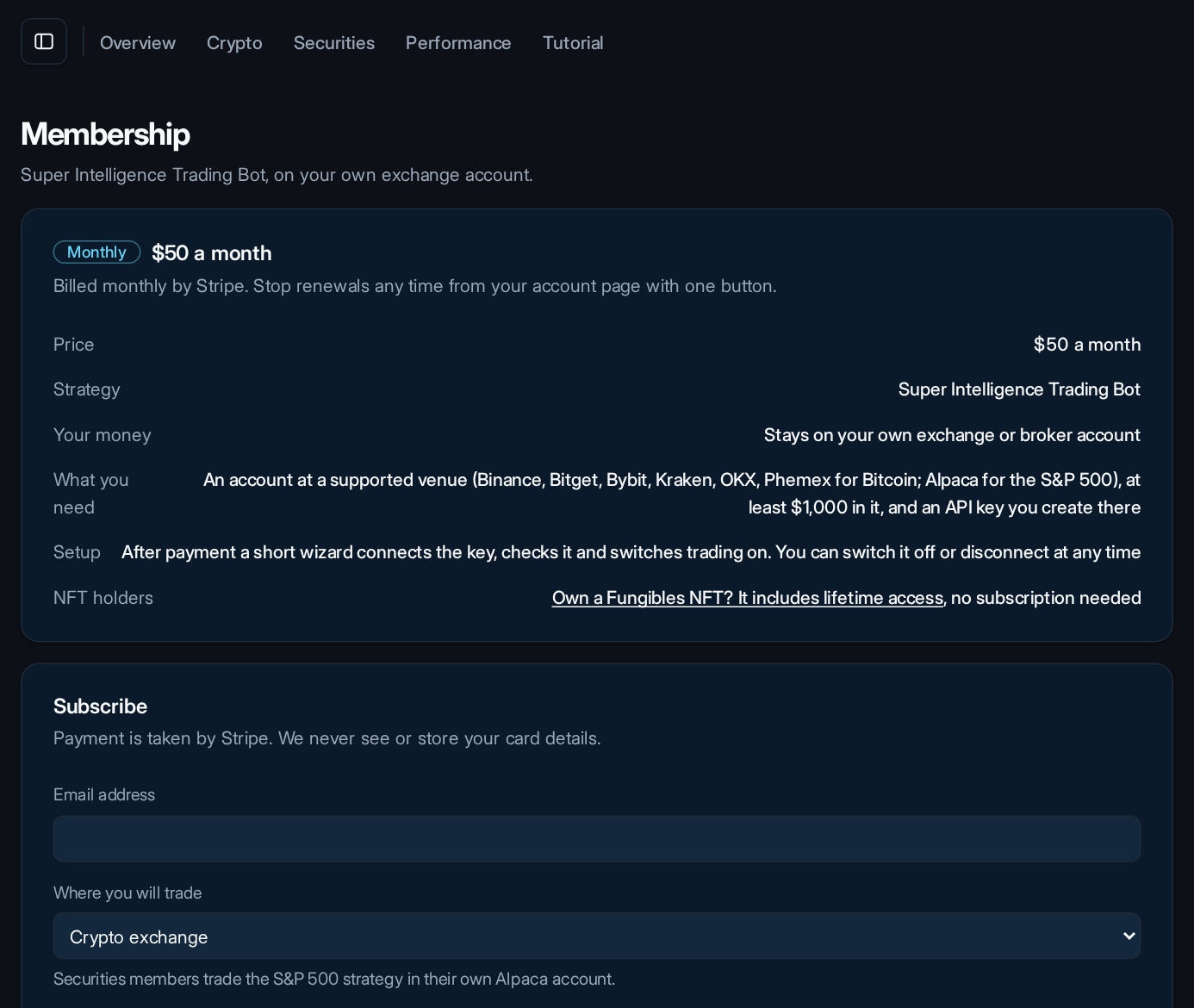
Signing in. No password to remember. Type your email on the sign-in page and a one-time link is sent to you. Open it and you are in. NFT holders can also sign in with their wallet.
In one lineA flat fee for the software. Nothing is ever taken from your account by Thistle.
Chapter 5 · Getting set up33 of 53
Choosing your venue
For Bitcoin, pick one exchange. For the S&P 500 there is one broker.
For Bitcoin: Binance, Kraken, Bybit, OKX, Phemex and Bitget. They all trade the same market by the same decisions. Your result does not depend on which you choose. Pick by what suits you:
- One you already have. No need to open another.
- One that serves your country. Each exchange lists the countries it accepts when you sign up. Not every exchange accepts every country.
- One that takes your bank's currency cheaply. Look at how you can deposit: a local bank transfer is usually the cheapest way.
- One whose website you find clear. You will use it to put money in and take it out.
For the S&P 500: Alpaca, a stock broker in the United States that accepts customers from many countries. It checks your country when you sign up.
If you want both strategies you will have two accounts: one at an exchange for Bitcoin and one at Alpaca for the S&P 500.
In Thistle's set-up wizard, the page where you choose has a link to open an account at each one.
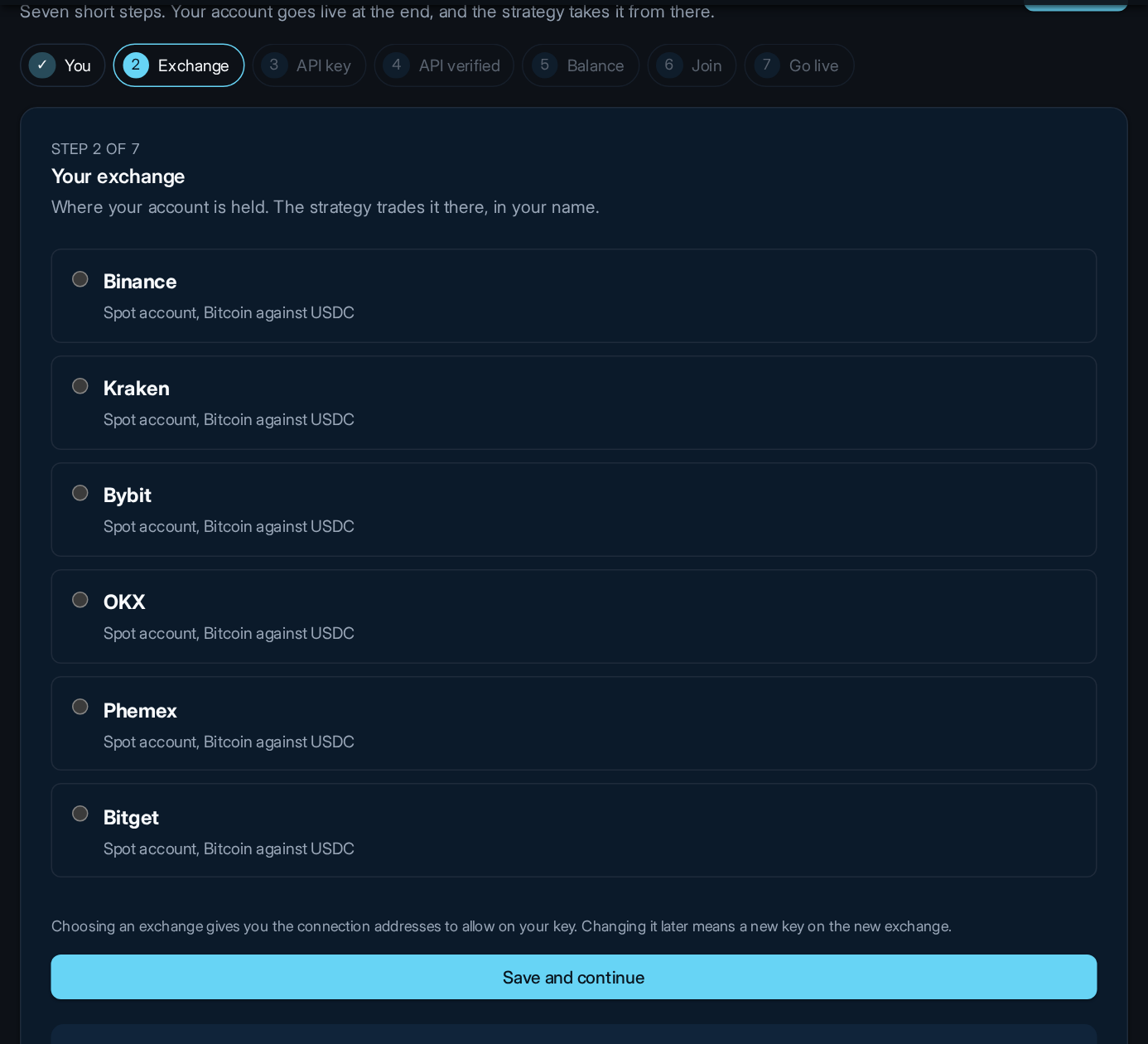
In one lineAny of them works. Choose the one that accepts your country and your bank.
Chapter 5 · Getting set up34 of 53
Opening the account
The same few steps at every venue.
- Sign up. Enter your email or phone number and choose a strong password that you use nowhere else.
- Confirm your email. The venue sends a code or a link.
- Prove who you are. Photograph your ID and take a selfie. Some ask for a bill or statement showing your address. This is the identity check, . It is required by law and can be approved in minutes or take a few days.
- Switch on two-step login. The venue calls it 2FA or two-factor authentication. After your password it asks for a six-digit code from an app on your phone. Do this before any money goes in.
- Answer the questions. Many venues ask about your experience and where your money comes from. Answer truthfully.
Write down, on paper, the email you used and where your two-step codes come from. Losing access to your phone without a backup is the most common way people lock themselves out.
CarefulOnly ever sign up on the venue's real website or official app. Thistle's wizard links to the right pages. Never follow a link from a message or an advert.
In one lineSign up, prove who you are, turn on two-step login. Then you are ready for money.
Chapter 5 · Getting set up35 of 53
Finding your way around an exchange
Every exchange has the same rooms. Only the names on the doors differ.
An exchange's website looks crowded. You need only a few parts of it.
| The part | What it is | What you do there |
|---|---|---|
| Assets or Wallet | The list of what you own: dollars, USDC, Bitcoin | Check your balance |
| Deposit | Where money comes in | Send money from your bank, or receive USDC |
| Buy crypto or Convert | A simple swap of one thing for another | Turn your euros, pounds or dollars into USDC |
| Spot or Trade | The live market with prices and order boxes | Nothing. Thistle places the orders here |
| Transfer | Moving money between your own pockets inside the exchange | Move USDC into the pocket the strategy reads |
| API or API Management | Where passes for software are made | Create the key for Thistle, once |
| Withdraw | Where money goes out | Send money back to your bank |
| Security | Password and two-step login | Set up once, then leave |
The pockets. Most exchanges split your account into pockets with names like Funding, Spot, Trading or Unified. A deposit often lands in one and has to be moved to another before it can be traded. The next page says which pocket each exchange uses.
Leave these alone: Futures, Margin, Loans, Options, Copy trading, Earn, Launchpad and anything offering a bonus. Thistle uses none of them.
In one lineAssets, Deposit, Convert, Transfer, API, Withdraw. Ignore the rest.
Chapter 5 · Getting set up36 of 53
What each exchange calls things
Where your USDC must sit, and what to keep switched off.
| Exchange | Your USDC must be in | A deposit lands in | Keep switched off |
|---|---|---|---|
| Binance | Spot account | Spot Wallet if you choose it, otherwise Funding. Move with Assets, Transfer | Auto-Subscribe and One-Click Earn |
| Bybit | Unified Trading account | Funding, unless you route it to Unified Trading. Move with Assets, Transfer | Do not move money into Earn |
| Kraken | Spot balance | Spot | Auto Earn and rewards for USDC and Bitcoin |
| Bitget | Unified Trading Account | Sometimes Funding. Move with Transfer | Simple Earn Auto-Subscribe |
| Phemex | Spot account | Spot | Savings Auto-Transfer |
| OKX | Trading account | Funding or Trading. Choose Trading, or move with Assets, Transfer | Borrowing. Use Spot mode |
Why "Earn" has to stay off: these features quietly move your money out of the trading pocket to earn a little interest. The strategy then finds nothing to buy with and nothing to sell.
A few things particular to one exchange:
- Kraken: the key is made in the part of the site called Kraken Pro.
- Bybit: the key can only be made on the website, not in the app.
- OKX: the connection works with accounts on the main OKX site. Accounts on OKX's separate European, US and Australian sites cannot be connected yet.
- Bitget and OKX: when you create the key you also invent a third secret, called a passphrase.
Exchanges rename their menus often. If a name here does not match, look for the nearest word. The wizard shows the exact buttons for the exchange you chose, with pictures.
In one lineMoney in the right pocket, Earn switched off. That is most of it.
Chapter 5 · Getting set up37 of 53
Finding your way around Alpaca
The broker for the S&P 500 strategy is simpler than an exchange.
A broker has no pockets to move money between and no digital dollar. Your account holds ordinary US dollars and shares.
| The part | What it is | What you do there |
|---|---|---|
| Live and Paper | Two accounts in one login. Paper is play money for practice | Make sure you are looking at Live |
| Banking or Transfers | Money in and out | Send dollars from your bank |
| Positions | What you hold | See your IVV shares, or your Treasury bill fund |
| Orders and Activity | Every buy and sale | Check what was done |
| API Keys | Where the pass for software is made | Create the key for Thistle, once |
When the strategy is waiting in dollars you will see a holding called SGOV in your account. That is a fund of short-term US government bills, where the cash earns a little interest while it waits. It is as close to cash as a broker account gets.
The key from Alpaca has two parts, a Key ID and a Secret Key, and no list of approved addresses. Keep it private.
In one lineOne account, real dollars, and make sure it says Live.
Chapter 5 · Getting set up38 of 53
How to put money in
From your bank, to your venue, into the right form.
For Bitcoin, at an exchange:
- Send money from your bank. Open Deposit, choose your currency, and the exchange shows bank details and a reference code. Make a normal bank transfer to them from an account in your own name, with that reference. Card payments also work but cost more.
- Wait for it to arrive. It can be minutes or up to three working days.
- Turn it into USDC. Open Convert or Buy crypto, choose from your currency to USDC, and confirm. Now you hold digital dollars.
- Check the pocket. Make sure the USDC is in the pocket named on the last page. If not, use Transfer.
That is all. You do not buy Bitcoin yourself. The strategy does that when its rules say so.
For the S&P 500, at Alpaca: open the money transfer page and send US dollars from your bank. If your bank account is in another currency, your bank changes it into dollars and charges for that. Then nothing more: the dollars wait in the account until the strategy buys.
CarefulAlways send a small amount first, wait until it shows in your account, then send the rest. If someone sends you USDC from another wallet instead, the chosen on both sides must be the same, or the money can be lost.
In one lineBank transfer in, convert to USDC, right pocket. Start with a small test.
Chapter 5 · Getting set up39 of 53
The API key: a pass, not your password
How Thistle is allowed to trade without ever being able to take money out.
An is a pass that you create at your venue for one piece of software. It is not your password and it cannot be used to log in as you.
It has two parts, both long strings of letters and numbers: the key, which is like a username, and the secret, which is like its password. Some exchanges add a third part you invent yourself, the passphrase.
When you create it, you tick what it is allowed to do:
| Permission | For Thistle |
|---|---|
| Read: see balances and orders | Yes |
| Trade: place buy and sell orders on spot | Yes |
| Withdraw: send money out | Never |
| Transfer, loans, margin | No |
One more lock. Most exchanges let you list the internet addresses that may use the key. Thistle's wizard gives you its own addresses to paste in. With that list in place the key works only from Thistle's servers. Even someone who stole it could not use it.
You stay in charge. Delete the key at your venue and Thistle's access ends that second. Nothing else is affected.
This is the real screen at each venue, set the way Thistle needs it. Choose yours:
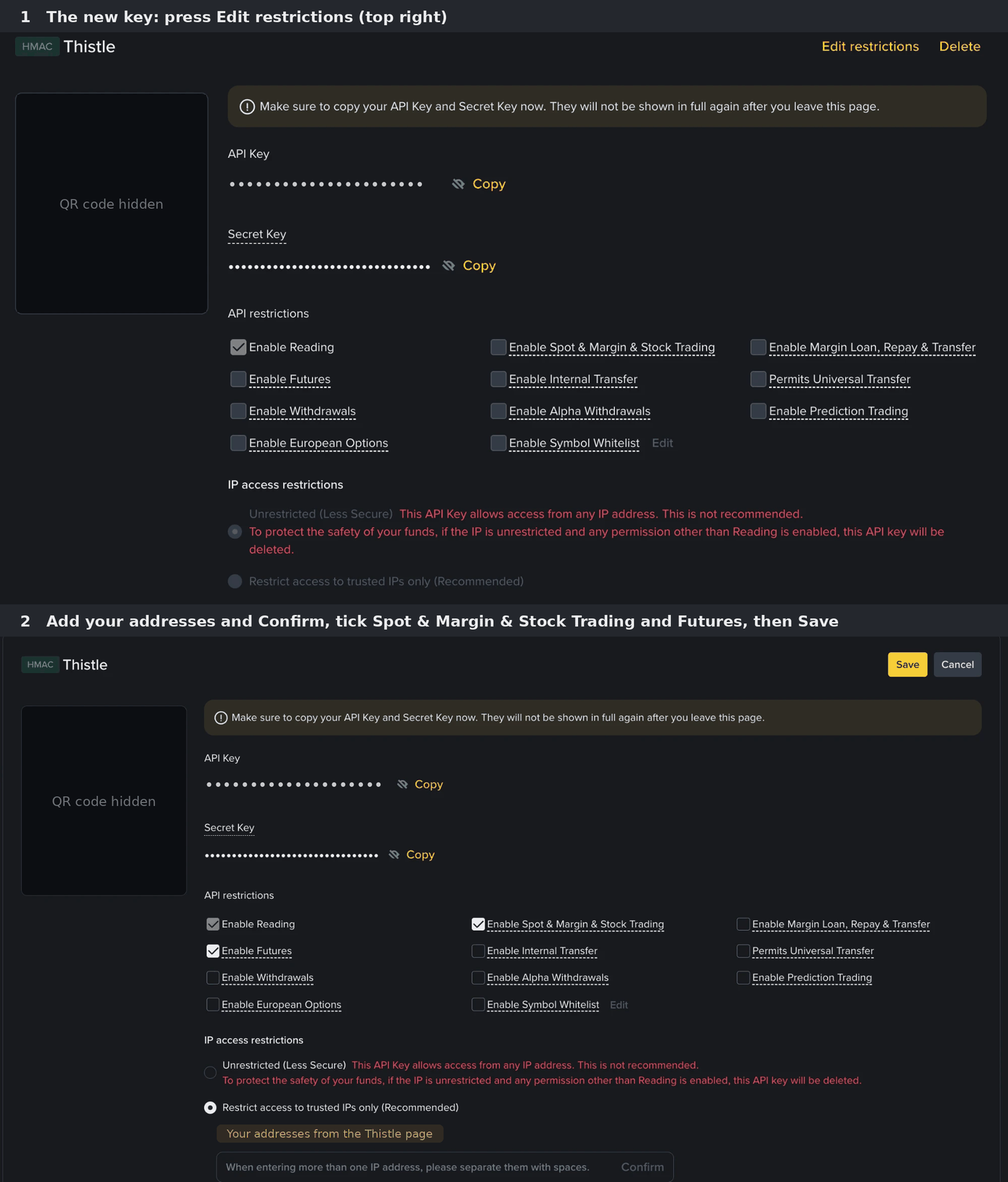
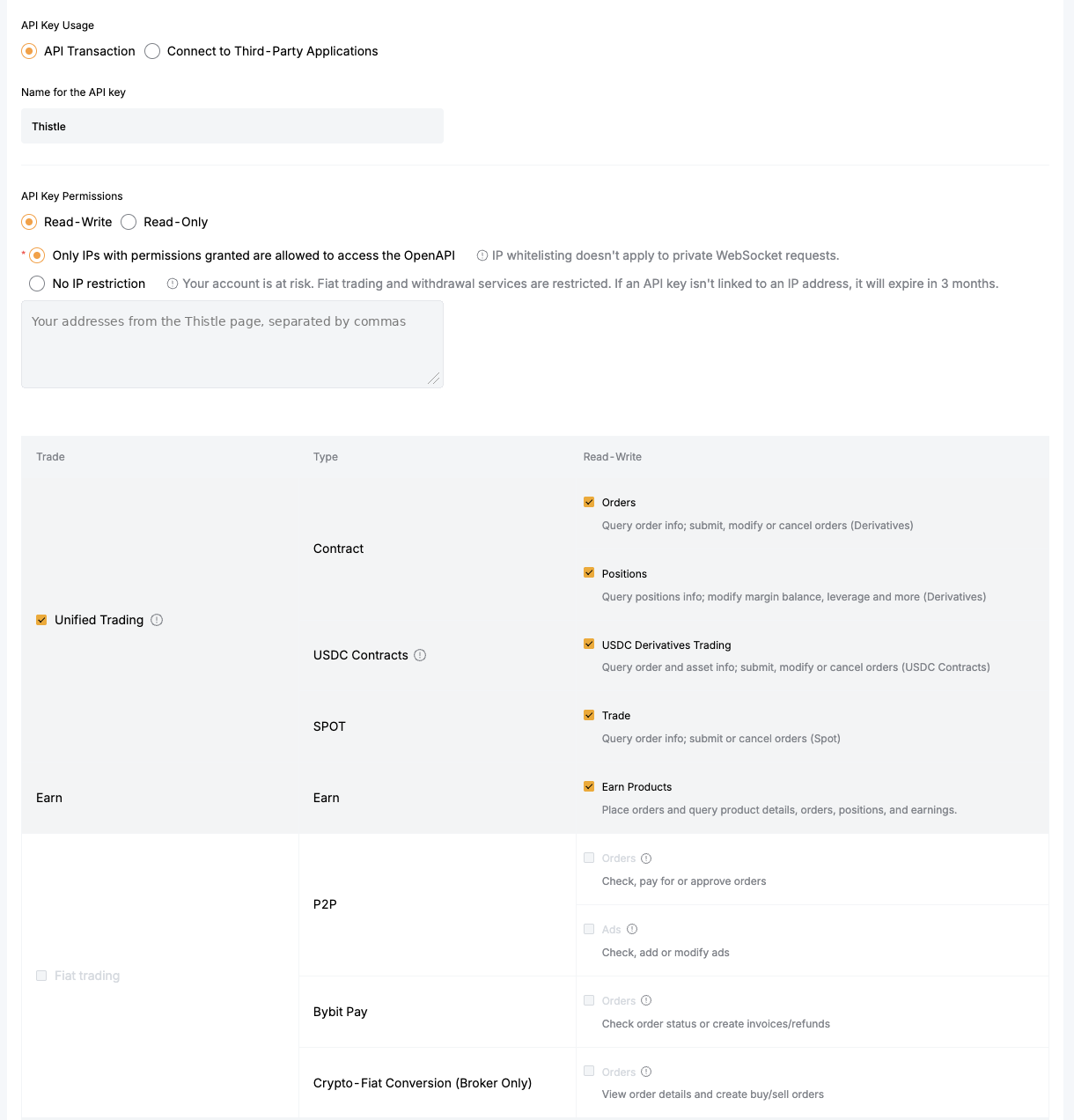
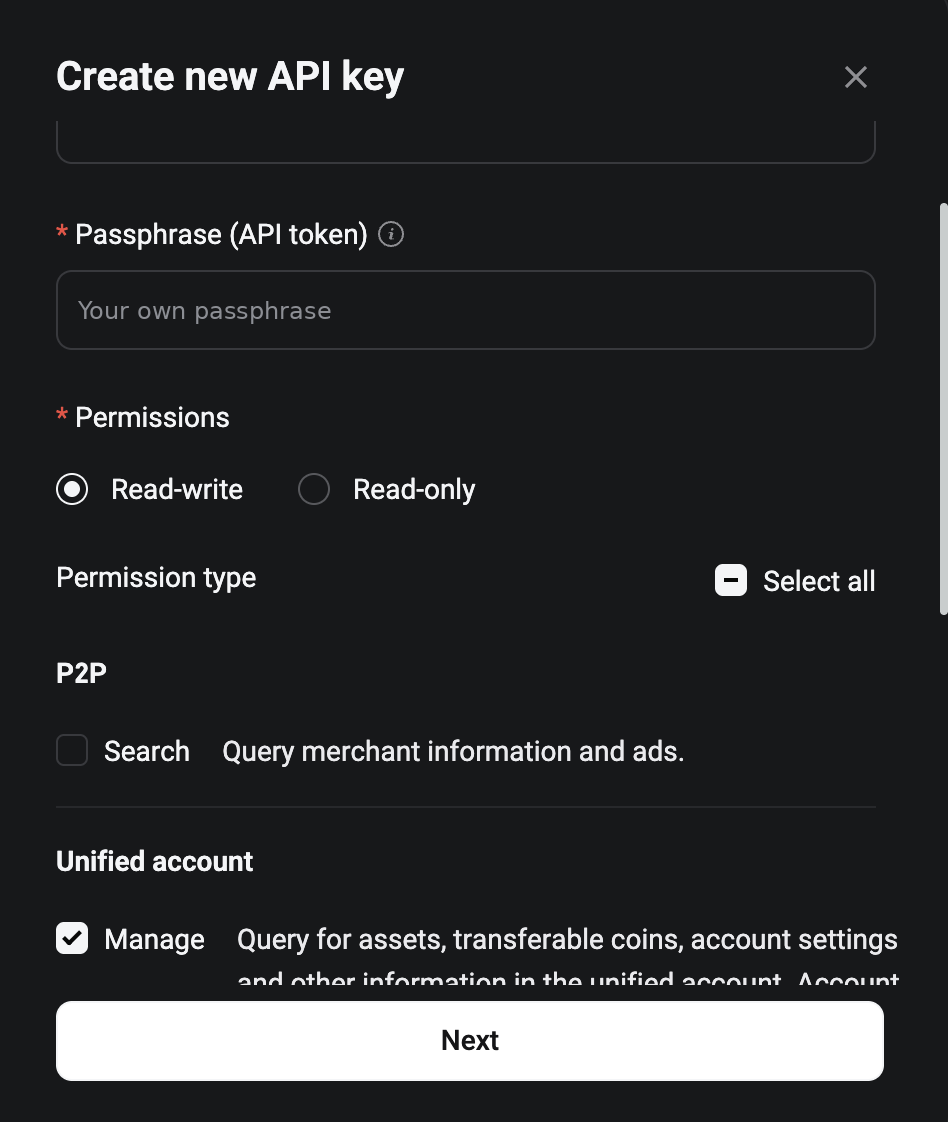
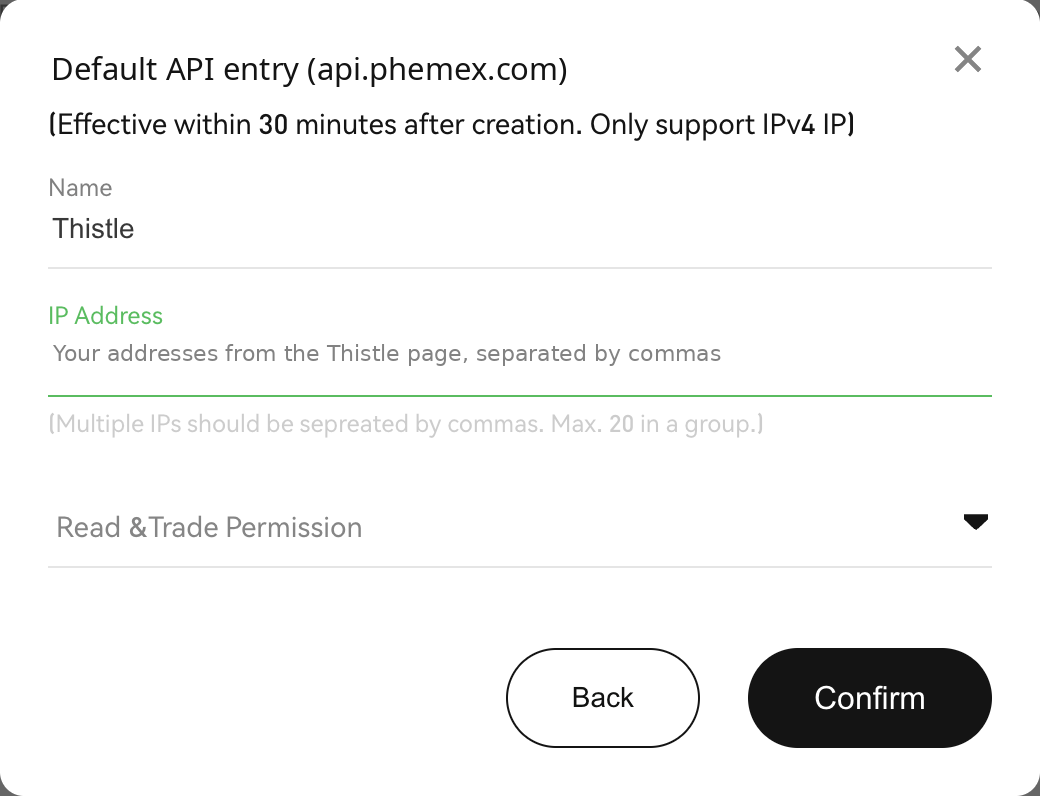
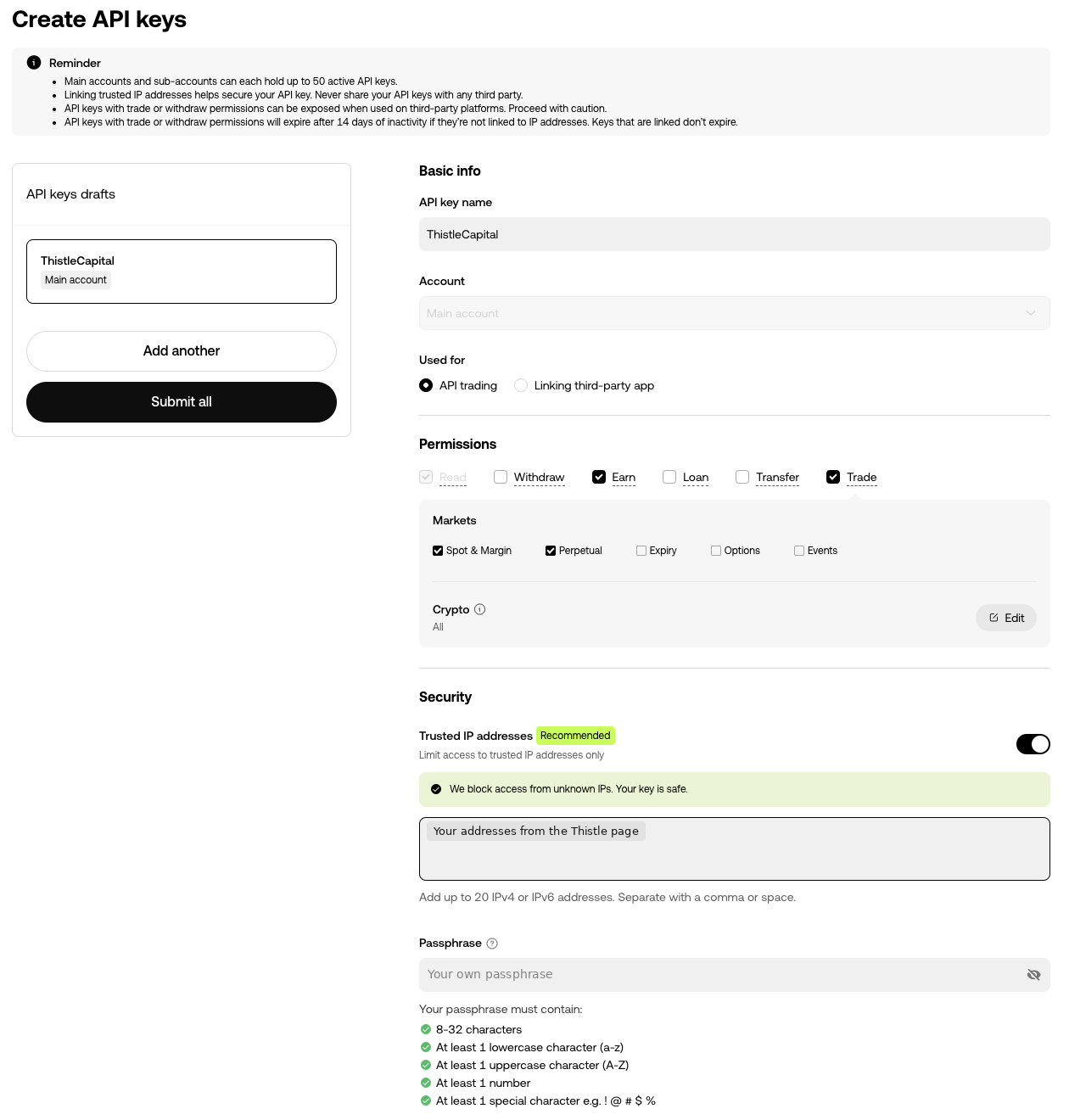
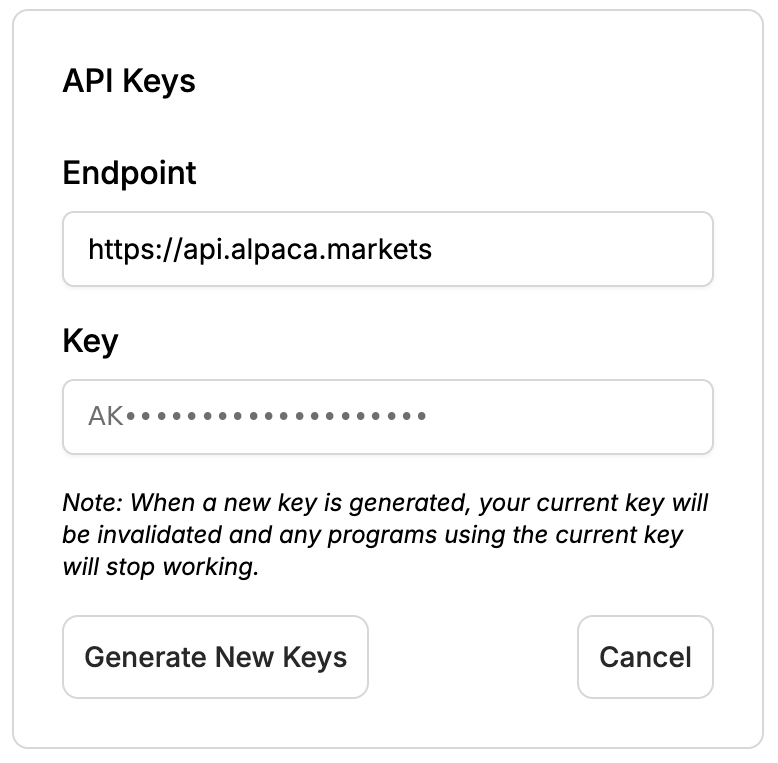
CarefulThe secret is shown only once, when you create the key. Copy it straight into Thistle's wizard. Never give the key to any other person, website or app, and never tick Withdraw.
In one lineA pass that can trade and look, and can never take money out.
Chapter 5 · Getting set up40 of 53
Connecting to Thistle: the seven steps
A wizard takes you through it. It saves as you go, so you can stop and come back.
Sign in and open Set up my account. You will see seven steps.
- You. Your name and the email Thistle writes to.
- Exchange. Choose your venue. There is a link there to open an account if you have none yet.
- API key. The wizard shows, with pictures, exactly which buttons to press at your venue, and gives you the addresses to paste in. Then you paste the key and the secret into Thistle.
- API verified. Thistle uses the key to read your balance once. Nothing is bought and nothing is moved. This proves the key works.
- Balance. Thistle shows what it found and checks it against the minimum.
- Join. You choose how your account joins the strategy. The next page explains the two choices.
- Go live. A summary of everything. Press the button and trading is switched on for your account.
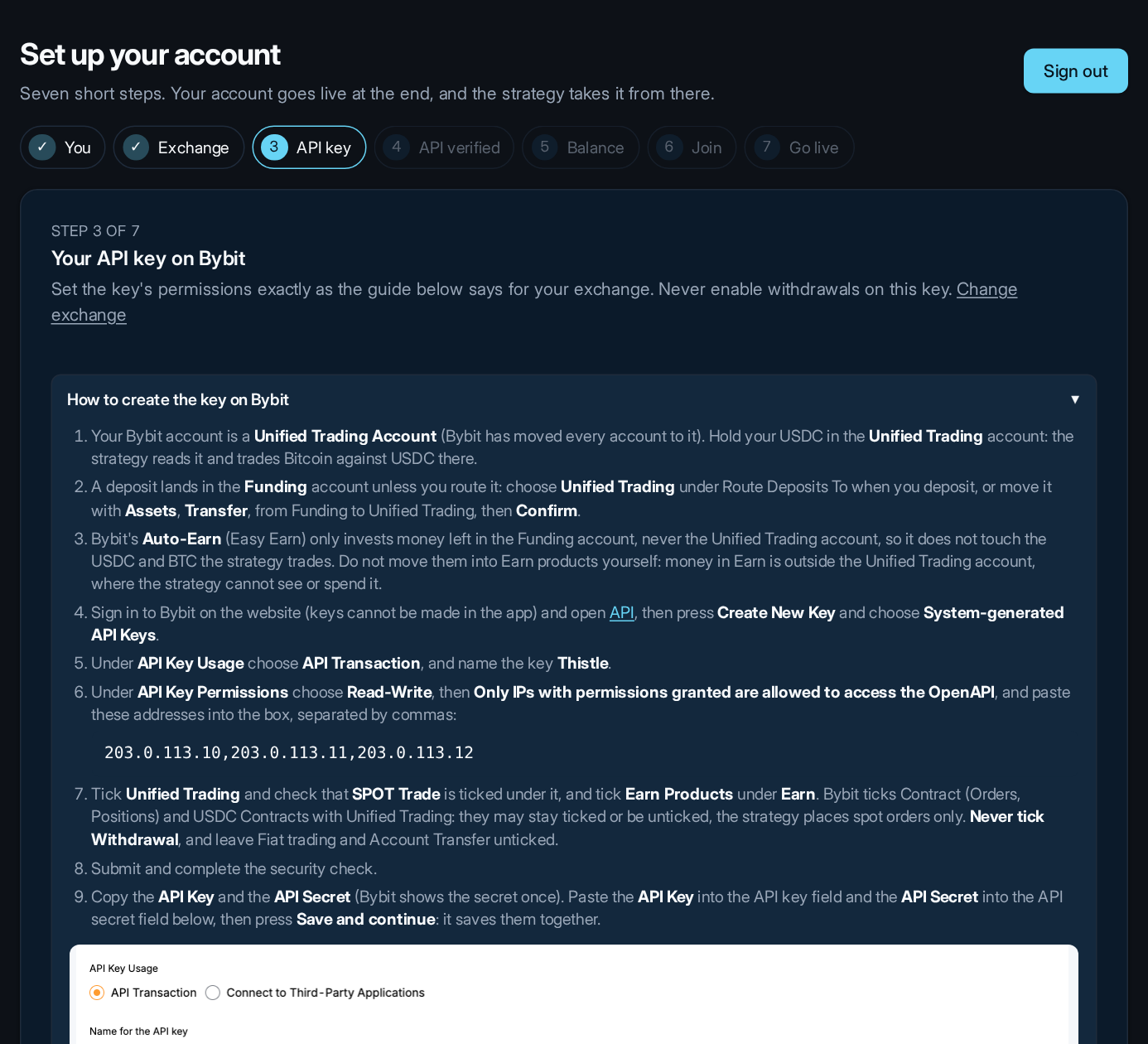
Your key is stored so that it is never shown again, not to you and not on any page.
If a step fails, the wizard tells you why in plain words. The usual causes are a missing tick on the key, an address left out of the list, or money sitting in the wrong pocket.
In one lineSeven small steps, about 15 minutes, with pictures for your exchange.
Chapter 5 · Getting set up41 of 53
Enter now, or wait for the next signal
The one real decision in the set-up.
The strategy is already running when you arrive. It may be in the middle of holding, or in the middle of waiting. You choose how to step in.
Enter now. Your account copies the strategy as it stands today, at your full balance. If it is holding Bitcoin, yours is bought straight away at today's price.
- Good: you are in from day one and take part in whatever comes next.
- The catch: your buying price is today's, not the price the strategy bought at months ago. If the market drops next week, your account is down while the record still shows a gain.
Wait for the next signal. Nothing is bought until the strategy makes its next move. You then start exactly in step with it.
- Good: you begin at a fresh decision, not in the middle of one.
- The catch: the next move can be weeks or months away. Your money sits untouched in your account until then.
Neither is right for everyone. If watching an early loss would shake you, wait. If sitting idle would frustrate you, enter now. Over several years the difference fades.
In one lineEnter now to be in today. Wait to start cleanly at the next decision.
Chapter 6 · Living with it42 of 53
After you go live
There is nothing you have to do. Here is what you will receive.
- An email for every trade. What was bought or sold, at what price, and where your holding now stands.
- A weekly summary on Mondays, and a monthly summary at the start of each month.
- An email if something needs you: your key stopped working, your balance fell below the minimum, or a membership payment failed.
Where to look. Your account page on Thistle shows your venue, your balance as last read, and your settings. Your venue's own website shows the same holdings, because they are the same thing: Thistle only reports what is in your account.
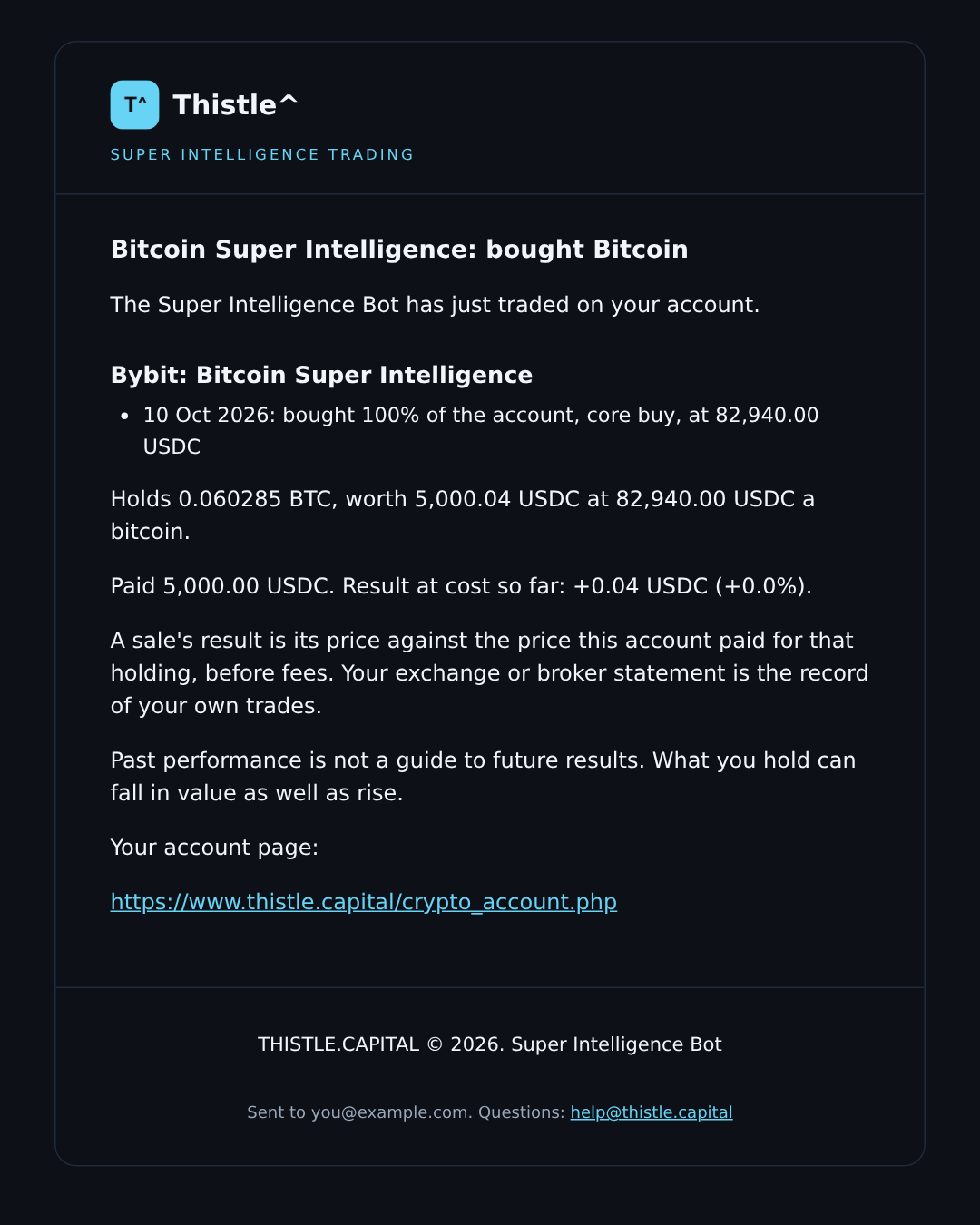
How often to look. Once a month is plenty. Checking every day makes the bumps feel bigger than they are and tempts you to interfere.
In one lineRead the emails, check once a month, and otherwise leave it be.
Chapter 6 · Living with it43 of 53
The one rule: hands off what the system has open
The account is yours, but the open trades in it belong to the strategy. Do not touch them.
Once you are live, your spot account shows what the system is doing: the Bitcoin or the fund it has bought, and sometimes orders that are waiting to be filled. Treat all of it as the system's work in progress.
Do not tamper with an open trade. That means, in the account the system trades:
- Do not add to it. Do not buy more of the same thing by hand.
- Do not close it. Do not sell what the system bought.
- Do not reduce it. Do not sell a part of it.
- Do not cancel or change its orders. An order you see waiting was placed by the system for a reason.
The system expects to find the account exactly as it left it. If it does not, its next order can be the wrong size, can fail, or can sell something you meant to keep. It will not know that you changed anything.
Do not change the balance, unless you accept what follows. Your balance is your size. If you withdraw money, or move it to another pocket or product, the account is smaller, and from then on the system trades the smaller amount. Every later gain is earned on less. That is your right, and it is fine if it is what you want. Just do it knowing the result.
Adding money is always fine. The system sees the larger balance and puts it to work for you. The next page explains how.
If you need to do any of this, do it the clean way: turn trading off on your account page first, make your change, and turn it back on. The page on taking money out shows how.
CarefulThis is the most common way members hurt their own results. One sale by hand in a bad week can undo months of the strategy's work.
In one lineLook, do not touch. And only take money out if you are happy to trade less.
Chapter 6 · Living with it44 of 53
Adding more money
Whenever you have spare capital, put it in. The system notices and does the rest.
You can add more USDC to your exchange account, or more US dollars to your broker account, at any time and as often as you like. It is the simplest way to put unused capital to work and let it grow with time.
You do not have to tell Thistle, press anything, or buy anything yourself. The system reads your balance regularly, sees that it is larger, and brings your account back into line by itself:
- While the strategy is holding, it buys the extra into the holding, so the new money is in the market alongside the rest.
- While the strategy is waiting in dollars, it makes its planned steps larger, so the new money is used as the price reaches each step.
From then on every decision is traded at the larger balance.
Three things to know:
- Put it in the right place. At an exchange, turn it into USDC and make sure it is in the pocket the strategy reads. Money left in another pocket is not seen.
- Very small amounts wait. A top-up of a few dollars is too small for the exchange to accept as an order. It is left in the account and used with the next trade.
- The new money buys at today's price. If the strategy is holding, your added money goes in at the price of that day, not at the price the strategy bought at earlier.
This is the opposite of the hands-off rule, and the reason for it: you change the balance, the system does the trading.
In one lineAdd money any time. The system trades the larger balance and adjusts for you.
Chapter 6 · Living with it45 of 53
Do and do not
A few habits keep everything working.
Do
- Add money whenever you like. Your balance is your size: the system sees a top-up, buys it in or resizes for you, and trades the larger balance from then on. Convert it to USDC and put it in the right pocket.
- Keep your venue login safe. Strong password, two-step login, and a backup of how you get your codes.
- Read Thistle's emails. Especially any that say something needs your attention.
- Tell Thistle before you change venue. A new venue means a new key.
- Use an account that holds only what the strategy should trade. The strategy sizes its orders from the USDC and the Bitcoin it finds in that account. Bitcoin you already keep there is treated as part of it and can be sold. Keep other savings in a separate account, or a separate sub-account if your exchange offers one.
Do not
- Do not touch an open trade. Do not add to it, close it, reduce it, or cancel its orders. See the page before this one.
- Do not change the balance unless you accept trading less. A withdrawal makes the account smaller, and the system then trades the smaller amount.
- Do not trade Bitcoin against USDC yourself in the same account. Your own orders and the strategy's become one position, and the strategy will trade all of it.
- Do not move the money into Earn, Savings or any other product. The strategy cannot see it there.
- Do not edit or delete the key, or its address list, unless you mean to stop.
- Do not let the balance sit below the minimum. Below it some orders are too small for the exchange to accept.
- Do not switch off in a panic. Decide your limits now, calmly, not on the worst day.
In one lineTop up freely, keep it secure, and do not trade the same thing by hand.
Chapter 6 · Living with it46 of 53
Using your earnings, and taking money out
It is your account and you can take money out. Know first what that does to what the system trades.
Gains are never paid out to you separately. They simply stay in your account, as more USDC or more Bitcoin, more dollars or more fund shares, and the next trade uses the larger amount. That is the growth on growth from earlier.
To take money out, you do it at your venue, not at Thistle:
- Pick your moment. The simplest time is when the strategy is waiting in dollars, because then your account holds USDC or cash, ready to go. Your account page and your last trade email tell you which state it is in.
- Turn it into your currency. At an exchange, use Convert from USDC to your bank's currency. At the broker it is already dollars.
- Withdraw. Open Withdraw, choose your bank account, enter the amount and confirm with your two-step code. It arrives in one to three working days.
While the strategy is holding Bitcoin or the fund, there is no spare cash in the account, so taking money out would mean selling part of the system's open trade. Do not do that with trading switched on. If you cannot wait for the strategy to step aside, switch trading off on your account page first, sell what you need, withdraw, and switch it back on. The system then carries on with what is left.
Leave at least the minimum in the account if you want to keep trading: 1,000 USDC or 1,000 USD.
CarefulEvery withdrawal makes your account smaller, and the system trades what is there. After you take money out it trades the lower amount, and every later gain is earned on less. Take money out only if you are happy with that.
In one lineTake money out at your venue, ideally while the strategy is waiting in dollars.
Chapter 6 · Living with it47 of 53
Pausing, and stopping for good
Three switches, all in your own hands.
Pause trading. On your account page, turn trading off. No new orders are placed. Whatever was already bought stays in your account exactly as it is. Turn it back on when you are ready.
Stop the membership. On the same page, stop renewals. Nothing more is charged, and the software keeps trading for you until the end of the month you have paid for. A lifetime member has nothing to stop.
If a monthly payment fails, you get an email and a few days to put it right. If it is not put right, trading for your account stops. What you hold stays in your account as it is.
Cut the access. Delete the API key at your venue. Thistle can no longer read or trade your account at all.
After any of these, your account is still yours, with everything in it. If it holds Bitcoin or fund shares and you want cash, sell them yourself at your venue and withdraw.
CarefulPausing while the strategy is waiting in dollars is clean. Pausing while it holds means you now own that Bitcoin or fund without anyone watching the exit. Decide what you will do with it.
In one lineOff on your account page, or delete the key. Everything stays yours.
Chapter 6 · Living with it48 of 53
What it costs, and tax
Every cost, including the ones nobody mentions.
| Cost | Who takes it | How much |
|---|---|---|
| Membership | Thistle | $50 a month, or nothing with a lifetime NFT |
| Trading fee | Your venue | A small part of one per cent of each trade. The broker charges no commission on the fund |
| Changing currency | Your bank or venue | Usually under one per cent each way |
| Deposit and withdrawal | Your bank or venue | Often free by bank transfer, more by card |
| The fund's own cost | Inside IVV | 0.03% a year |
Because the strategies trade rarely, trading fees stay small. The membership is the cost to weigh: on a balance of 1,000 USDC it is a real slice each year, and on a larger balance it hardly shows. The site's figures leave the membership out, so take it off in your own head.
Tax. In most countries a gain made when something is sold is taxable, and every sale by the strategy can count. The rules differ from country to country.
- Keep Thistle's trade emails. They are a ready record of every buy and sale.
- Your venue lets you download your full trade history at any time.
- Thistle does not give tax advice and does not report for you. If in doubt, ask an accountant in your country.
In one lineA flat membership, small venue fees, and your own tax to look after.
Chapter 6 · Living with it49 of 53
Staying safe
Almost every loss of money in this world comes from a trick, not from the market.
Thistle will never:
- ask for your venue password, or your two-step codes;
- ask you to send money or crypto to Thistle, or to anyone;
- ask you to tick Withdraw on a key;
- message you first on social media, or ask you to install anything;
- promise a return.
Anyone who does any of these in Thistle's name is a thief. Stop and write to help@thistle.capital.
Good habits
- Type the address of your venue and of Thistle yourself, or use a saved bookmark. Fake copies of exchange websites are common.
- A different, long password for your email and for each venue. Your email is the key to everything else.
- Two-step login on your email and your venue.
- Nobody genuine will ever hurry you. Pressure is the mark of a scam.
- Tell one person you trust that these accounts exist and where your records are. Accounts nobody knows about are hard for a family to recover.
In one lineNobody honest needs your password, your codes, or your money sent to them.
Chapter 6 · Living with it50 of 53
When something looks wrong
The common worries, and what they mean.
| What you see | What it usually means | What to do |
|---|---|---|
| "My balance went down" | The market fell while the strategy was holding | Nothing. This is normal. See the page on what you will see |
| "Nothing has happened for weeks" | The strategy is holding, or waiting. No decision is due | Nothing |
| "The key check failed" | A tick missing, an address left out, or the key is too new | Follow the wizard's message and press Check again |
| "It says my balance is too low" | The USDC is in the wrong pocket, or in Earn | Move it with Transfer |
| An email about your API key | The key was changed, expired or deleted at the venue | Make a new key in your account settings |
| An email about a payment | The card for your membership was declined | Update the card on your account page |
| "It sold at a loss" | The strategy stepped aside | Nothing. It is part of how it works |
If you are stuck, write to help@thistle.capital and say which venue you use and what you see on the screen. Never include your password, your key's secret or your codes.
In one lineMost worries are the strategy doing exactly what it should.
Chapter 6 · Living with it51 of 53
Quick answers
The questions almost everybody asks.
| The question | The short answer |
|---|---|
| Can I lose all my money? | Your account can fall a long way, and Bitcoin could in theory go to nothing. You can never lose more than you put in |
| Can Thistle take my money? | No. The key cannot withdraw, and the money never leaves your own account |
| Do I have to watch it? | No. Read the emails, look once a month |
| Do I have to understand trading? | No. You need to understand this guide, and nothing more |
| Can I start with less than the minimum? | The minimum is 1,000 USDC or 1,000 USD. Below it, some orders are too small to be placed |
| Can I add money later? | Yes, at any time. The system sees the larger balance, buys it in or resizes for you, and trades the larger amount from then on |
| Can I take money out? | Yes, at your venue. The system then trades the smaller amount that is left, so only do it if you accept that |
| Can I buy or sell a bit myself in that account? | No. Never add to, close, reduce or cancel what the system has open |
| Can I use both products? | Yes. One membership, two accounts: one at an exchange, one at Alpaca |
| Can I use the exchange account I already have? | Yes, but keep only the strategy's money in it. See the page on what to do and not do |
| Does it trade at night and at weekends? | Bitcoin, yes, at any hour. The S&P 500 only on weekdays, in New York hours |
| How often does it trade? | Rarely. Weeks or months can pass between orders |
| What does Thistle earn? | The flat membership, and at some exchanges a partner commission paid by the exchange out of its own fee. No share of your gains |
| What if I change my mind? | Turn trading off, or delete the key. Everything in the account is yours |
| Who do I ask? | help@thistle.capital |
In one lineIf your question is not here, it is probably on the page about that step. Use Contents.
Chapter 6 · Living with it52 of 53
You are ready
Everything on one page.
- Thistle is software that trades Bitcoin and the S&P 500 by fixed rules.
- Your money stays in your own account, at an exchange or a broker, in your name.
- Thistle gets a pass that can trade but never withdraw.
- It holds in rises, steps aside in falls, buys back lower, and returns.
- It never borrows. You can lose what you put in, never more.
- The record is strong and it includes deep falls. Expect both.
- It needs years, and long quiet stretches are normal.
- You need ID, a bank account, the minimum, and about an hour.
- Costs are a flat membership and small venue fees.
- You can pause, withdraw or leave at any time.
- Hands off the open trades. Never add, close or reduce them, and only change the balance if you accept trading less.
- Add money whenever you like. The system trades the larger balance and adjusts for you.
If any line surprises you, go back to its page before you put money in.
In one lineUnderstand it first. Then start small, and give it time.
Reference53 of 53
A to Z: every word explained
The words of the trade used in this guide, in plain language.
- API key
- A pass you create at your venue for one piece of software. Thistle's can read your balance and place trades. It can never withdraw.
- Bear market
- A long stretch in which prices mostly fall.
- Benchmark
- What you compare a result with. Here it is always "what if I had simply bought and held?"
- Bitcoin
- Digital money with no issuer and a fixed supply of 21 million. Its short name is BTC.
- Broker
- A company allowed to buy and sell shares and funds for you, in an account in your name.
- Bull market
- A long stretch in which prices mostly rise.
- Buy and hold
- Buying something and keeping it through every rise and fall, doing nothing.
- Cash account
- An ordinary broker account that can only spend the money in it. The opposite of a margin account.
- Compounding
- Growth earned on earlier growth, because gains are left in the account.
- Core buy
- The strategy's main purchase: the whole balance going into the market when a rise is established.
- ETF
- A fund you can buy and sell on the stock market like a single share.
- Exchange
- A company where you can hold, buy and sell Bitcoin and other digital coins, in an account in your name.
- Fund
- Many people's money pooled to buy a spread of investments, here every company in the S&P 500.
- Futures
- Bets on a future price, usually made with borrowed money. Thistle does not use them.
- Grid buy
- One of the planned smaller purchases the strategy makes at lower and lower prices during a fall, each sold again a step higher.
- Index
- A list of investments taken together and tracked as one number, such as the S&P 500.
- KYC (identity check)
- Short for "know your customer". The identity check every venue must do by law before you can trade.
- Leverage
- Borrowing to make a bet bigger than your own money. It multiplies gains and losses. Thistle never uses it.
- Margin
- Trading with money borrowed from the venue. Thistle never does.
- MetaMask
- A widely used app that holds digital collectibles and coins. NFT holders can sign in to Thistle with it.
- Network
- The route a digital coin travels on when it is sent between wallets. Sender and receiver must choose the same one.
- NFT
- A digital collectible with a recorded owner. Thistle's are called Fungibles, and owning one gives lifetime membership.
- Pair
- A market written as two things, like BTC/USDC: the first is what is bought and sold, the second is what it is priced in.
- S&P 500
- About 500 of the largest companies listed in America, taken together. The usual measure of the US stock market.
- Shorting
- Betting that a price will fall. Thistle never does.
- Spot
- Buying or selling the real thing, paid for in full, right now. The opposite of futures and margin.
- Stablecoin
- A digital coin designed to stay worth one unit of a normal currency, usually one US dollar.
- Stop loss
- An order that sells automatically when the price falls to a set level. Thistle does not use them.
- Strategy
- A fixed set of rules for when to buy and when to sell.
- The record
- An account of 1,000 followed through every decision of a strategy since 2021, shown on the site beside simply holding.
- Treasury bills
- Very short loans to the US government. About the safest place to keep dollars, paying a little interest.
- Trend
- The general direction of a price over months: mostly rising or mostly falling.
- Two-step login (2FA)
- A second check after your password, usually a six-digit code from an app on your phone.
- USDC
- A digital US dollar: a coin meant to always be worth one dollar, used on crypto exchanges in place of bank dollars.
- Venue
- Thistle's word for the exchange or broker where your account is.
- Worst fall (drawdown)
- The drop from a high point to the low that followed. The honest measure of how bad it got.