
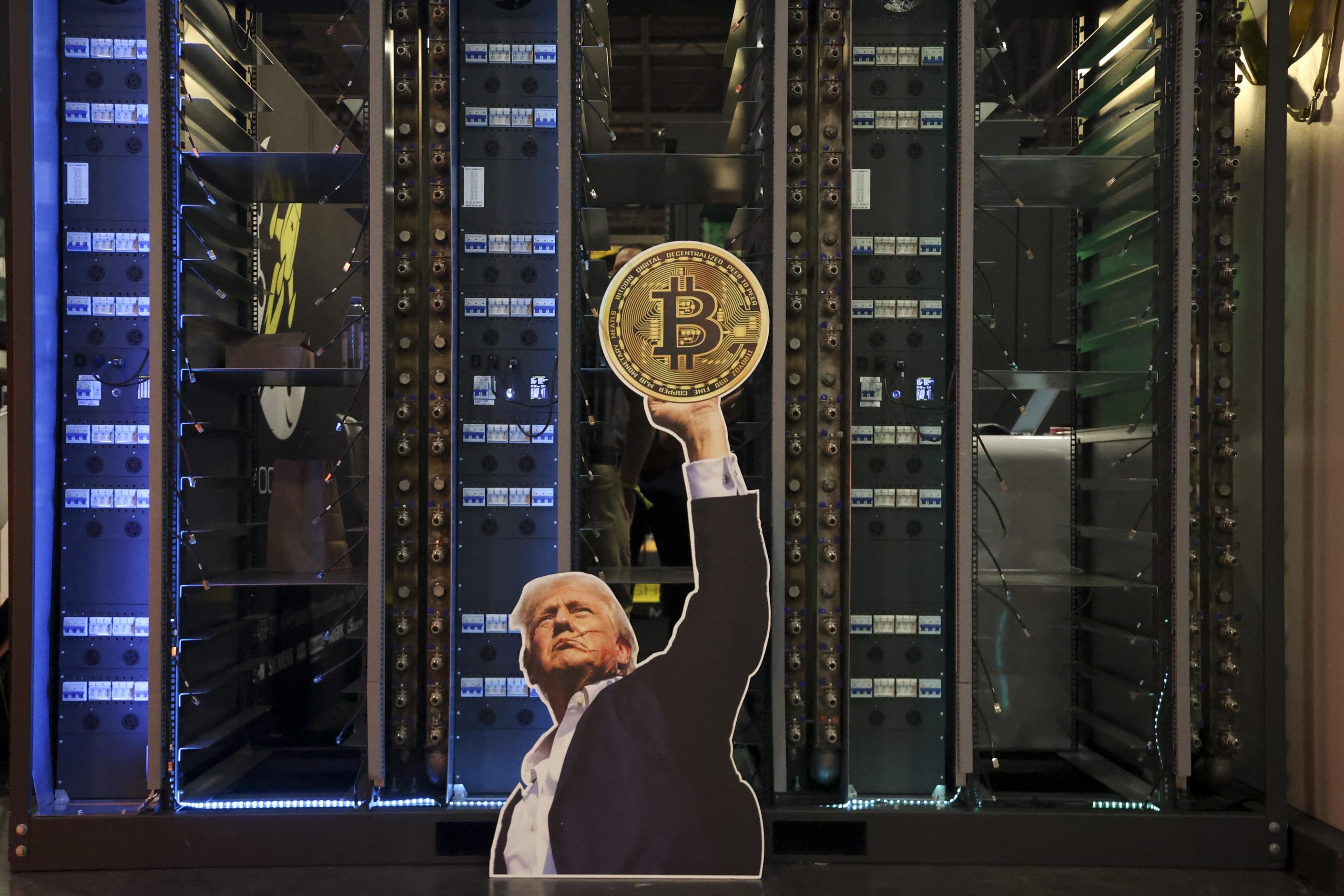
"He said Bitcoin is gone in four years," Lauryn Williams cut in, half laughing, as her co-guest tried to soften a prediction he had made an hour earlier. The four-time Olympian was not exaggerating. David McAlvany, the CEO of the gold app Vaulted, had said exactly that on the On The Margin podcast.
"I think we're four years away from Bitcoin going away," McAlvany said. "And I say that because within four years we have quantum computing, and that is the end of Bitcoin. The blockchain ceases to exist for all intents and purposes. You can solve all the math problems instantly."
It is a startling thing to hear from someone whose business depends on the asset Bitcoin was built to challenge. It also arrives at a moment when the trade McAlvany is selling looks better than it has in years. Gold has spent 2026 above $4,000 an ounce, down from a January record near $5,600. Goldman Sachs raised its 2026 gold target to $5,400 in January, noting that gold exchange-traded funds account for just 0.17% of U.S. private financial portfolios. And in a report published in early June, the European Central Bank found that gold made up 27% of global central bank reserves at the end of 2025, ahead of U.S. Treasuries for the first time in decades.
McAlvany's pitch for all of this comes wrapped in an unusual marketing vehicle: real gold, handed to Olympic athletes.
"I didn't know that all financial advisors are not created equally," Williams said on the On The Margin podcast, describing the advisor she hired at 20 after signing with Nike. "I ended up in the hands of someone who sold me a bunch of financial products, didn't teach me anything about financial literacy." A second firm later invested a group of NFL players' money in a casino that never opened. Williams, who is the first American woman to medal at both the Summer and Winter Games, went on to become a certified financial planner and founded her own fee-only firm, Worth Winning. Most Olympians, she says, are nowhere near as rich as fans assume. "I once worked with an Olympic gold medalist who earned $100,000 in the year they won their medal, and just $30,000 the following year," Williams said. "Think of yourself more like an influencer. Olympians have been influencers from day one." The costs run the other way. "We're entrepreneurs for lack of a better term," she said. "Our job is to keep our bodies, which are the Ferraris, running at top speed, and it takes top quality products to be able to do so." Even the medal disappoints. "One of the most disappointing things to find out was that the gold medal was only gold plated," Williams said. Vaulted gives participating Olympians $30,000 in physical gold they can hold, track or sell from a phone. "We're moving the conversation from trophies to true wealth," McAlvany said in announcing the program, which has featured Williams and Olympic bobsled champion Elana Meyers Taylor.
"Is it something that will be here five thousand years from now?" McAlvany said of Bitcoin. "Gold, I'm pretty sure will be. Bitcoin may or may not be." His whole timeline hangs on quantum computing arriving sooner than almost anyone expects, and he points to the layoffs already rippling through technology. "Just look at all of your big tech companies who are laying off tens of thousands of people," he said. "Why? Because AI does the work of the coders more effectively, more efficiently." Extrapolate that, he argues, and quantum follows. "I have no idea if it's four years from now, five years from now, or two months from now. But they're on a path towards quantum computing." Bitcoin has heard this before. Coinbase CEO Brian Armstrong issued his own quantum warning earlier this year, telling developers to "solve it now." Most cryptographers are less alarmed. A code-breaking machine is widely seen as a decade or more away, and Bitcoin can upgrade its cryptography through a soft fork if one gets close. Author Michael Terpin is not worried at all. "If you look at the last decade, Bitcoin destroys any other asset class," the investor and Transform Group founder said on the On The Margin podcast. "We're still only around 4% of the world that has any Bitcoin, maybe about 8% that has crypto," Terpin said.
"They think it's no better than a pet rock," McAlvany said of the Wall Street brokers who tell clients to skip gold. He concedes Warren Buffett's old complaint, that bullion sits in a vault and produces nothing, then tries to engineer past it. "If Buffett understood more about the precious metals market, he would come to a different conclusion," he said. By trading the ratio between gold and silver prices, he claims, an investor can stack metal over time. "I've doubled the number of ounces that I have without adding any more money to my metals portfolio." Henry McPhie is chasing the same complaint with crypto instead of against it. "Now all of a sudden gold is no longer the pet rock that sort of sits there. You actually have an interest component to it," McPhie, whose firm Streamex issues a gold-backed token, said on the On The Margin podcast. His token pays a yield on top of the metal price, and it settles on the kind of blockchain rails McAlvany expects to vanish. "If you have an asset that gives you gold price plus up to 400 basis points, it's all of a sudden a much better asset for people to own," McPhie said.
"You've seen a doubling of central bank demand since 2022, and it's consistent," McAlvany said. "What do they want? They want agency." Central banks bought roughly 1,000 tonnes of gold in each of 2022, 2023 and 2024, more than double the previous decade's average, according to the World Gold Council. "Gold is a guarantee of agency anywhere in the world," McAlvany said. "To be an agent is to be someone who can act in their own interest." He traces the rush to one event. After Russia invaded Ukraine in 2022, Western governments immobilized about $300 billion in Russian reserves, most of it sitting at Euroclear in Belgium. The money was frozen, not seized, but other central banks drew the lesson anyway. The same fear of a fraying dollar system is driving Russia and others toward bitcoin and pushing Wall Street to treat which reserve asset wins as a live question. "Gold is old, it is archaic," McAlvany said. "A healthy medium of exchange, a great store of value, and I think it will survive. I think it will live longer than Bitcoin."
What you keep "If you bet on yourself, whatever it is that you're betting on, you will win," Williams said, returning to the advice she leans on most: invest in yourself before anything else. McAlvany traces his own version to the late investor John Templeton, who told him to save 51% of his income. "This kid kind of walked away dejected. He's like, I know, I don't wanna save fifty one percent of my income," McAlvany said, recalling another young man given the same advice. He took it anyway. "Spend less, save more, invest the difference, don't take any big losses," he said. "Compounding is the eighth wonder of the world." Where the difference belongs, in gold or Bitcoin or a savings account, is the fight he and a generation of crypto investors are still having. "What you earn matters," McAlvany said, "but what you keep matters more."